
Modern enterprises are drowning in customer data while remaining completely starved of actionable context. Over the past twenty years, organizations have invested billions into customer relationship management (CRM) software, anticipating that centralized databases would unlock seamless customer experiences and explosive revenue growth. Instead, enterprise teams find themselves wrestling with disconnected point solutions, bloated spreadsheets, and manual administrative overhead that pulls high-value employees away from direct customer engagement.
The underlying issue is structural. Traditional CRMs were built around a single paradigm: the system of record. They were architected to serve as passive digital filing cabinets—rigid data tables engineered to store contacts, accounts, deals, tickets, and activities after human workers painstakingly enter them. But customer relationships do not unfold in static database rows. They happen in live, fast-moving conversations across telephone calls, WhatsApp threads, email exchanges, web chats, and SMS messages.
When communication channels sit disconnected from the underlying database, a severe organizational blind spot emerges: a chasm between what actually occurred in a conversation and what the organization understands and records. Closing this divide requires moving beyond passive databases to a fundamentally different paradigm: an AI-powered customer platform that acts as both a system of intelligence and a system of action. Your CRM shouldn't just store customer data. It should understand it.
The Problem With Traditional CRM
To understand why customer platforms require a foundational rebuild for artificial intelligence, enterprise leaders must first confront the architectural limitations of legacy CRM software.
Traditional CRM systems were designed in the early 2000s to solve a desktop-era administrative problem: giving managers visibility into pipelines and customer contact histories. They achieved this by establishing structured relational schemas centered on Accounts, Contacts, Leads, Opportunities, and Support Cases. Every piece of intelligence inside the system was predicated on a human employee sitting at a keyboard, manually summarizing a phone call, copying text from an email, selecting dropdown values, and clicking save.
This model breaks down in high-velocity, modern operating environments for three reasons:
1. The Manual Data Entry Tax: Sales representatives and support agents spend up to 30% of their working hours performing administrative post-contact maintenance—logging call notes, updating deal stages, tagging dispositions, and generating follow-up reminders. This overhead introduces cognitive fatigue, depresses employee morale, and pulls skilled professionals away from revenue-generating or problem-solving activities.
2. Inevitable Data Hygiene Degradation: Because data entry is manual and subjective, CRM quality depends entirely on individual rep discipline under pressure. Notes are rushed, dropdowns are skipped or populated with default values, and nuanced customer objections are lost. Over time, the CRM degrades from an authoritative source of truth into an incomplete, untrusted historical archive.
3. The Understanding Gap: Traditional CRMs record historical transactions, but they are blind to real-time intent, underlying sentiment, and operational context. A legacy system can tell an executive that a deal stalled in stage three or that a customer logged four support tickets last month. What it cannot convey is why: that the customer expressed severe frustration over onboarding delays during a WhatsApp exchange, or that a prospect asked specific questions about enterprise data sovereignty during a technical voice call.
Why Customer Data Is Still Fragmented
The breakdown of traditional CRM is accelerated by the explosion of modern digital and voice communication channels. Today’s buyers and customers interact across a fluid matrix of touchpoints: inbound phone calls, WhatsApp messages, direct emails, SMS updates, and in-app web chats.
Rather than unifying these interactions into an integrated architecture, most enterprise IT departments assembled a "stitched franken-stack":
• A standalone Cloud PBX or VoIP contact center system to handle inbound voice calls.
• A third-party WhatsApp Business API provider or mobile gateway for messaging.
• A dedicated marketing automation platform for bulk outbound email and SMS broadcasts.
• A separate ticketing helpdesk for customer service inquiries.
• A legacy CRM acting as a passive database, attempting to sync with these external channels via brittle point-to-point webhooks and nightly ETL batch jobs.
This architectural fragmentation generates eight severe operational symptoms across the enterprise:
1. Repeated Customer Explanations: Customers must re-state their identity, issue, and history every time they transition from a chat thread to a phone call.
2. Crippling Swivel-Chair Overhead: Frontline agents toggle between five to eight separate browser tabs and desktop applications just to handle a single customer inquiry.
3. Lost Conversational Context: Crucial commitments made over WhatsApp or phone calls never get reflected in the CRM record, creating blind handoffs between departments.
4. Inflated Average Handle Times (AHT): Agents spend minutes searching across disjointed tools to locate order numbers, prior conversation threads, or account status.
5. Disconnected Customer Profiles: Marketing campaigns target prospects with introductory offers while support teams are actively addressing unresolved escalations with the same account.
6. Compliance and Consent Exposure: Opt-out requests, Do Not Call (DNC) directives, or regulatory constraints captured on one channel fail to propagate in real time to outbound dialers or SMS pipelines.
7. Stale, Delayed Analytics: Executive dashboards reflect batch data that is hours or days old, preventing real-time operational intervention during volume spikes.
8. Disproportionate Integration Maintenance: Engineering teams burn expensive sprint cycles maintaining brittle API bridges and data pipelines rather than delivering core business value.
What Is an AI Powered CRM?
An AI CRM is not a legacy relational database with an LLM text-rewriting plugin bolted onto the interface. It represents a unified architectural evolution where the communication layer (voice, WhatsApp, email, chat), the data layer (entities, custom objects, relationships), and the intelligence layer (natural language processing, reasoning agents, real-time analytics) operate within a cohesive engine.
In an AI CRM, unstructured conversations are automatically converted into structured, governed customer intelligence without requiring human data entry.
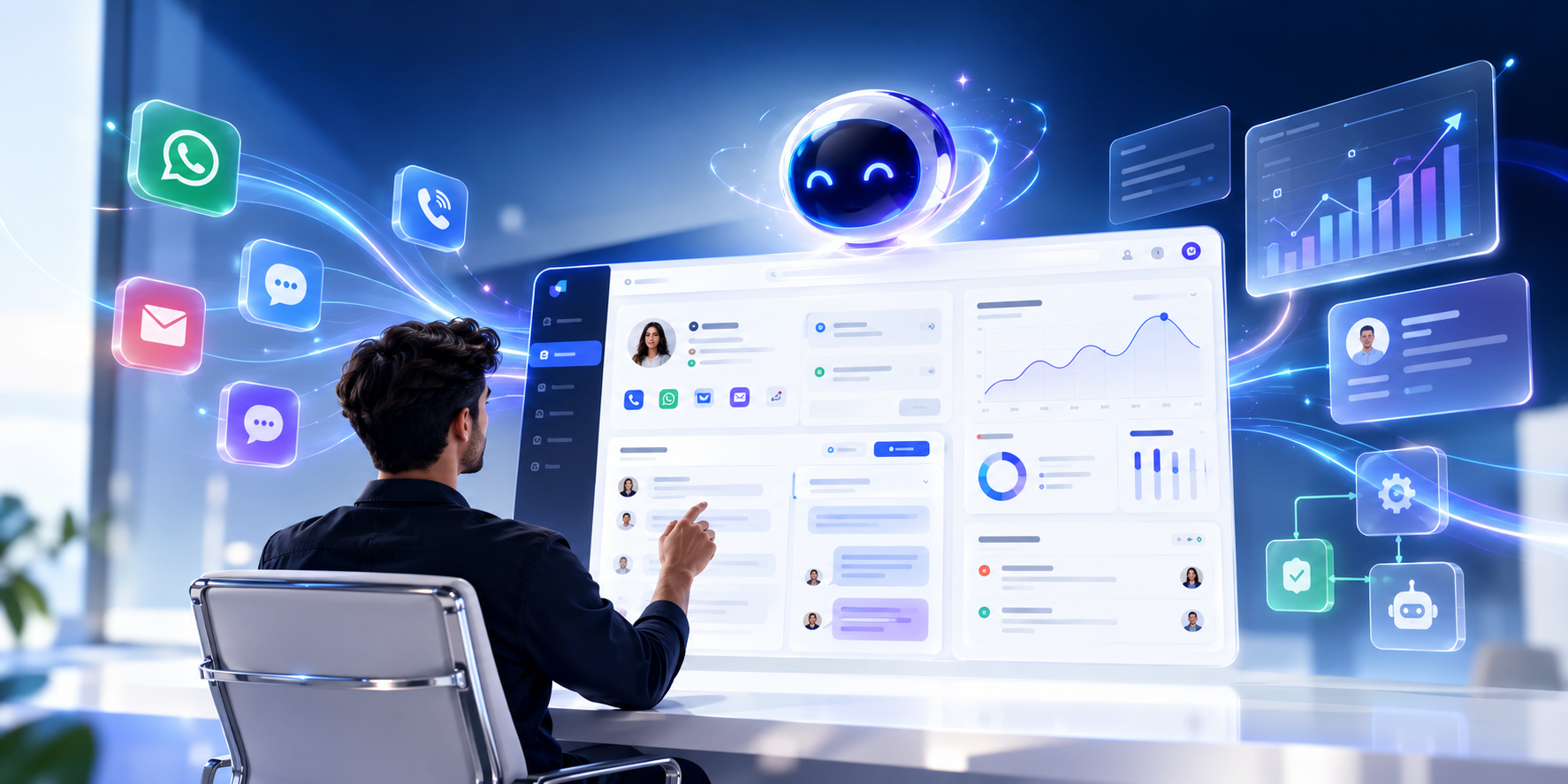
Architectural Comparison: Traditional CRM vs. AI Powered CRM
The structural, operational, and architectural differences between legacy systems of record and modern AI-powered customer platforms span every dimension of the customer lifecycle:
| Capability | One orchestration platform | A stitched stack |
|---|---|---|
| Data Entry | Autonomous extraction: intent, fields, summaries, and outcomes logged directly from live conversations. | Manual administrative input: reps write notes and manually update dropdown fields after every interaction. |
| Customer Context | Unified, persistent omnichannel timeline linking voice, WhatsApp, email, SMS, and custom CRM records. | Fragmented silos: call recordings in PBX, emails in mailboxes, chat in third-party widgets, stale notes in CRM. |
| Routing & Triage | Dynamic, predictive routing driven by real-time intent, emotional sentiment, SLA risk, and customer value. | Static, rule-based queues configured on basic metadata (e.g., round-robin, department codes) that degrade under load. |
| Workflow Automation | Event-driven multi-step orchestration triggered directly by conversational intent and outcome signals. | Rigid, conditional "If/Then" triggers reliant on reps manually changing record stage fields. |
| Customer Analytics | Conversational Business Intelligence: natural language queries (NLQ), root-cause analysis, and proactive anomaly alerts. | Static historical dashboards with predefined filters requiring dedicated data analyst sprint cycles to adjust. |
| Customer Support | Autonomous tier-1 voice and digital resolution with governed, context-rich handoffs to human agents. | Simple keyword deflection bots or manual ticket queuing that forces human agents to resolve every repeat inquiry. |
| Lead Management | Continuous behavioural and intent scoring derived from real-time customer dialogues across channels. | Static demographic scoring based on form fills, job titles, and periodic web page visits. |
| Administrative Load | Zero-data-entry architecture frees frontline teams to focus exclusively on empathetic engagement. | Consumes 20% to 30% of employee productive time on post-contact documentation and data cleansing. |
| Decision Support | Real-time in-conversation copilot: recommends next best action, relevant knowledge, and pre-drafted responses. | Passive reference: reps must manually query internal wikis, policy PDFs, or ask colleagues via chat. |
Data Entry
Customer Context
Routing & Triage
Workflow Automation
Customer Analytics
Customer Support
Lead Management
Administrative Load
Decision Support
The stitched stack feels cheaper until you count the integration tax, the duplicated outreach, the compliance exposure, and the hours your team spends reconciling spreadsheets instead of talking to customers.
The Shift From System of Record to System of Action
The core paradigm shift in enterprise software is the transition from systems of record to systems of action.
A system of record is inherently retrospective. It answers the question: "What happened in the past?" It functions as an archive, waiting for human intervention to read historical data, interpret implications, and execute manual workflows.
A modern AI customer platform operates as an active operational loop that answers three critical questions simultaneously: "What is happening right now?", "What does this mean for the business?", and "What should happen next?"
This operational loop is structured around four continuous phases:
1. Listen: The platform natively intercepts customer interactions at the communication layer—whether that interaction is an incoming SIP voice stream, an inbound WhatsApp message, a support email, or a live chat message. It does not wait for a transcript to be uploaded hours later.
2. Understand: Utilizing specialized natural language processing (NLP) and contextual language models, the platform resolves customer intent, identifies entities (such as account IDs, product names, or transaction numbers), evaluates emotional sentiment, and correlates the interaction with the customer’s complete historical record.
3. Decide: Grounded in enterprise policies, role-based governance, and playbook rules, the platform evaluates the optimal path forward: Should this request be resolved autonomously? Should an in-flight alert be sent to an account executive? Does this case require immediate human escalation with a proposed resolution pre-drafted?
4. Act: The platform executes downstream actions across the entire enterprise ecosystem. It writes structured fields back to the CRM, schedules follow-up tasks, adjusts pipeline stages, updates inventory or billing via APIs, and sends confirmation communications across the customer’s preferred channel.
Crucially, an enterprise AI platform balances assistance and autonomy. It does not assume that all tasks should run without human supervision. Instead, it provides a spectrum: executing repetitive low-risk operations autonomously while providing high-context, in-line augmentation for human decision-makers handling complex, nuanced, or high-stakes interactions.
What Is an AI Copilot?
In customer operations, an AI copilot operates side-by-side with sales representatives, support agents, and account managers. It eliminates the cognitive load of navigating between disconnected systems while a customer is waiting on the phone or in a live chat.
Key enterprise copilot capabilities include:
• Real-Time Knowledge Retrieval: Instantly locating verified enterprise documentation, pricing models, and troubleshooting steps based on the live dialogue, eliminating manual search.
• In-Conversation Response Drafting: Generating empathetic, policy-compliant replies tailored to the customer’s exact situation, pre-populated with account-specific variables.
• Next Best Action Guidance: Analyzing customer sentiment, buying signals, or churn indicators to recommend the optimal commercial offer or retention pathway.
• Post-Contact Summarization: Generating structured, objective summaries within seconds of interaction completion, detailing customer issues, root causes, agreed commitments, and required next steps.
Within Uniconnect AI, this intelligence layer is embodied by AURI, the native enterprise copilot that works directly inside the CRM and Omnichannel Inbox. Grounded in your company’s specific business logic and communication history, AURI assists reps during live conversations without requiring third-party tool switching.
What Is an AI Agent?
While an AI Copilot assists a human worker, an AI Agent acts independently within defined boundaries and guardrails.
In an enterprise customer platform, AI agents operate across voice and digital channels to deliver autonomous customer service, qualified lead triage, and routine operational fulfillment.
Core capabilities of production-grade AI agents include:
• Autonomous Voice Agents: Engaging in natural, interruptible voice phone conversations, processing speech with low latency, and completing operational tasks such as booking appointments, verifying order statuses, or capturing lead criteria.
• Tier-1 Deflection & Resolution: Handling high-volume repetitive inquiries across WhatsApp, chat, and email end-to-end—such as password resets, billing inquiries, and return authorizations.
• Governed API Execution: Securely reading and writing data across backend ERPs, payment gateways, and databases using validated scopes.
• Predictive Lead Qualification: Engaging inbound prospects immediately, verifying qualification criteria (BANT/MEDDIC), and scheduling qualified discovery calls directly on sales calendars.
• Context-Rich Hybrid Handoffs: Recognizing when an inquiry exceeds confidence thresholds, encounters emotional distress, or requires human empathy, and instantly transferring the conversation to a human specialist with complete contextual transcripts, extracted entities, and proposed solutions.
How AI Can Automate CRM Data Entry
Manual data entry is the primary bottleneck of enterprise CRM adoption and the single greatest source of CRM data decay. The traditional workflow imposes severe administrative drag on frontline teams:
The Traditional 5-Step Friction Loop:
1. Customer Interaction: Rep conducts a 15-minute phone call or multi-turn chat exchange.
2. Manual Note-Taking: Rep attempts to scribble disjointed notes while simultaneously trying to actively listen and engage the customer.
3. Post-Contact CRM Maintenance: Rep opens the CRM, navigates to the account, enters notes, updates custom dropdowns, and changes deal/ticket stages.
4. Task Scheduling: Rep manually creates calendar reminders and follow-up tasks for themselves or technical specialists.
5. Outbound Follow-Up: Rep drafts and sends a recap email summarizing the discussion from memory.
This friction loop wastes 10 to 15 minutes per conversation, introduces significant human error, and leads to missing records whenever queues are high.
The AI-Powered Zero-Data-Entry Workflow:
1. Live Conversation Capture: The platform natively streams the voice or digital interaction directly through the unified inbox.
2. Contextual Comprehension: The AI engine transcribes speech in real time, parses grammatical context, detects customer intent, and isolates key commercial entities.
3. Autonomous Record Update: The platform maps conversational signals to CRM fields, automatically updating account statuses, deal stages, and disposition codes.
4. Event-Driven Task Creation: Commitments made during the dialogue (e.g., "I will send over the revised proposal by Thursday") are automatically extracted and scheduled as assigned tasks with deadlines.
5. Drafted Multi-Channel Recap: An accurate follow-up message summarizing the discussion and next milestones is generated in the rep’s draft folder, ready for a single-click review and send.
By automating data capture directly from conversations, enterprises eliminate administrative fatigue, achieve 100% data coverage, and ensure complete transparency across all customer accounts.
Why Omnichannel Context Matters
From the customer's perspective, your company is a single entity. They do not distinguish between your voice support team, your WhatsApp operations desk, and your email sales reps. When forced to repeat their identity, account number, and issue history across different channels, customer frustration spikes and trust erodes.
Consider a typical enterprise customer journey:
• Touchpoint 1 (WhatsApp): A customer reaches out via WhatsApp inquiring about an unexpected invoice charge. An AI agent assists, verifies their account, and clarifies the line item, but the customer expresses a desire to adjust their underlying annual subscription terms.
• Touchpoint 2 (Voice Call): Two hours later, the customer calls the support line while commuting. In a legacy architecture, the voice agent has zero visibility into the WhatsApp conversation that occurred that morning. The agent asks: "Can I have your account number? How can I help you today?" The customer is forced to recount the entire morning exchange.
• Touchpoint 3 (Email): Following the call, the customer emails an updated purchase order. The sales representative handling the renewal receives the email without knowing that the customer experienced billing friction earlier that day.
In an intelligent customer platform, conversational context is persistent and channel-agnostic.
When the customer calls the phone line, the platform's unified telephony engine surfaces the morning WhatsApp transcript, the verified account details, and the pending subscription request directly on the agent’s screen before the call is answered. When the follow-up email arrives, it binds automatically to the same unified timeline.
Uniconnect AI accomplishes this by unifying native voice call infrastructure (powered by 3CX open PBX technology) with WhatsApp, SMS, Email, and Web Chat inside a single Omnichannel Inbox. Every touchpoint reads from and writes to the exact same customer data model in real time.
From Conversation to Action: The Intelligent Workflow Lifecycle
To see how an AI customer platform bridges the gap between raw conversation and business outcome, trace the end-to-end lifecycle of an enterprise interaction:
Customer Interaction Across Preferred Channel
A customer initiates an interaction via Voice, WhatsApp, Email, or Web Chat. The platform natively ingests the stream into a unified omnichannel communication engine.
Real-Time Intent & Sentiment Detection
As words are spoken or messaged, contextual NLP models evaluate semantic intent, extract key entities (order numbers, contract terms), and measure emotional trajectory.
Omnichannel Context Binding
The active conversation is correlated with the historical CRM timeline, open support tickets, past purchases, payment health, and previous channel threads.
AI Decision & Policy Evaluation
The platform evaluates enterprise rules and confidence thresholds to determine whether to execute autonomous resolution, trigger copilot assist, or perform priority routing.
Autonomous CRM Data Synchronization
Without human clicking, relevant fields, interaction summaries, sentiment flags, and stage updates are written directly to custom CRM objects and records.
Event-Driven Workflow Execution
Downstream business logic fires instantly: dispatching API calls to billing gateways, scheduling follow-up calendar tasks, or triggering targeted marketing sequences.
Contextual Human Handoff or Autonomous Closure
If human intervention is needed, the interaction transfers with complete notes, timeline history, and drafted next steps. If resolved autonomously, the case closes with customer confirmation.
Continuous Operational & Business Intelligence
Interaction telemetry streams into the unified semantic analytics layer, updating real-time KPI dashboards and feeding conversational intelligence for executive reporting.
How AI Changes Customer Support
Customer support operations have historically been treated as cost centers constrained by linear headcount scaling: to handle 30% more ticket volume, contact centers had to hire 30% more agents. An AI-powered customer platform transforms support into an agile, value-accretive operational engine.
Key Transformations in AI-Powered Support:
• Instant Autonomous Tier-1 Resolution: Routine, high-frequency requests—such as shipping status inquiries, password resets, booking modifications, and standard policy questions—are resolved autonomously across voice and messaging channels without queuing.
• Predictive Triage and Skill-Based Routing: Inbound inquiries are analyzed instantly for technical complexity, customer value tier, and urgency. Rather than basic round-robin assignment, cases route to the specialist best equipped to resolve the specific issue.
• Real-Time Sentiment Monitoring and Churn Prevention: The platform identifies rising customer frustration mid-conversation. Supervisors receive automated notifications, and high-risk interactions can be escalated to senior retention specialists before customer churn occurs.
• In-Workflow Agent Augmentation: Human support agents no longer search through disparate knowledge silos. The AI copilot listens to the interaction, retrieves verified policy documentation, and drafts responses that the agent can review, refine, and dispatch with a single click.
• Automated Ticket Hygiene and Case Wrap-Up: After-call work (ACW) is reduced to seconds. The system logs comprehensive case notes, categorizes root-cause codes, updates ticket lifecycle states, and triggers customer satisfaction surveys automatically.
How AI Changes Sales Operations
Sales teams routinely suffer from poor CRM hygiene, inaccurate pipeline forecasting, and low selling time. In many B2B organizations, account executives spend fewer than 35% of their working hours actively selling.
An AI customer platform systematically dismantles these sales operational bottlenecks:
• Instant Inbound Lead Engagement: Inbound prospects reaching out via web chat or WhatsApp are engaged within seconds by an intelligent agent that answers technical questions, qualifies budget and authority, and schedules discovery calls directly on sales calendars.
• Intent-Driven Lead Prioritization: Rather than relying on arbitrary demographic scoring models, the AI platform continuously evaluates real-time conversational signals, engagement depth, and buying intent across all channels to prioritize high-converting leads for sales outreach.
• Automated Call Logging & Pipeline Progression: Post-call administrative overhead is eliminated. Discussions with prospects are transcribed, key commercial objections and timeline requirements are extracted, and opportunity stages are updated in the CRM automatically.
• Real-Time Objection Handling: During live telephone calls, the AI copilot acts as a silent sales coach, surfacing competitive battlecards, proof points, and ROI metrics tailored to the specific objections raised by the prospect.
• Hyper-Personalized Follow-Up Generation: Within seconds of hanging up a call, an executive-ready follow-up email is drafted in the rep's inbox, citing the exact discussion points, agreed milestones, and customized collateral without requiring manual composition.
How AI Changes Customer Analytics: From Static Dashboards to Conversational Intelligence
Traditional business intelligence in customer operations is fundamentally broken. Business leaders rely on static dashboards configured months or years prior by IT specialists. When an executive needs an answer to a nuanced operational question—such as "Why did churn increase among mid-market accounts in the Northeast region last quarter?"—they must submit a ticket to the data engineering team and wait weeks for a report.
An AI customer platform introduces Conversational Business Intelligence and Natural Language Querying (NLQ) over a unified semantic data layer.
Instead of wrestling with complex SQL queries, multi-tab filter menus, or rigid dashboard widgets, operational leaders can query their customer data directly in plain language:
• "Which product features caused the highest volume of support escalations this month?"
• "Show pipeline progression by lead source and compare conversion velocity against last quarter."
• "What were the top three pricing objections raised during sales calls in the healthcare vertical this week?"
The platform reads across the unified interaction corpus, CRM custom entities, and operational metrics to generate immediate visual charts, tabular breakdowns, and written contextual explanations detailing what occurred, what drove the variance, and what strategic actions are recommended.
AI CRM Is More Than a Chatbot: Why Architecture Dictates Outcome
As artificial intelligence surged into mainstream enterprise awareness, many software vendors responded by taking legacy relational databases and bolting on third-party chatbot plugins or AI writing assistants. Enterprise buyers must understand why point-solution chatbots fail to deliver transformational value.
A superficial AI integration operates as a stateless widget: it receives a customer prompt, queries a generic LLM, and prints text. It lacks direct access to the underlying customer schema, cannot read the telephony stream, cannot update CRM custom objects, and cannot trigger governed enterprise workflows.
A true AI customer platform is an architectural paradigm shift characterized by three foundational layers:
1. The Native Communication Layer: Voice telephony (open PBX / SIP infrastructure), WhatsApp Business messaging, SMS gateways, and email servers operate natively inside the platform. Context is captured at the protocol level, not imported after the fact.
2. The Configurable No-Code Data Layer: An extensible, relational CRM core that allows operations teams to model custom business objects, relationships, and dynamic user layouts without writing bespoke code or paying massive developer fees.
3. The Governed AI Orchestration Engine: An embedded intelligence layer that combines real-time conversational listening, deterministic business rules, compliance filters, and bidirectional workflow execution across internal and external enterprise systems.
When these three layers are unified, artificial intelligence ceases to be a novelty writing tool and becomes the operational nervous system of the enterprise.
What an Enterprise Should Look for in an AI CRM: The Buyer's Checklist
When evaluating prospective AI customer platforms, technology and operational leaders should audit platforms against this practical 16-point architectural checklist:
- 1. Native Omnichannel Architecture: Unifies Voice calls, WhatsApp, Email, SMS, and Web Chat in a single real-time timeline without requiring third-party middleware.
- 2. Unified Customer Context: Preserves complete interaction history and account metadata seamlessly when customers switch between channels.
- 3. Embedded AI Copilot: Provides real-time, in-flight assistance to human reps, including grounded knowledge retrieval, next-best-action prompts, and drafted replies.
- 4. Autonomous AI Agents: Supports conversational voice and chat agents capable of resolving tier-1 inquiries end-to-end within strict enterprise guardrails.
- 5. Zero-Data-Entry Automation: Autonomously transcribes conversations, extracts commercial entities, and updates CRM fields, stages, and tasks.
- 6. No-Code CRM Extensibility: Empowers business operations teams to model custom objects, relational links, dynamic layouts, and validation logic without code.
- 7. Conversational Business Intelligence: Supports natural language querying (NLQ) over unified operational and customer interaction datasets.
- 8. Open Telephony Integration: Integrates open standard PBX/SIP architecture (such as 3CX) for high-performance, cost-effective global voice handling.
- 9. Multi-Channel Outbound Orchestration: Coordinates compliant, automated outreach campaigns across voice dialing, SMS, WhatsApp, and email.
- 10. Workforce Optimization & Adherence: Combines AI demand forecasting, schedule planning, and real-time agent adherence monitoring in the same workspace.
- 11. Deterministic Policy Guardrails: Native compliance filters that enforce regulatory phrasing, data privacy rules, and policy constraints across all interactions.
- 12. Explicit Human Handoff Protocols: Seamless transitions from autonomous agents to human specialists with zero context loss and pre-populated case notes.
- 13. Comprehensive Auditability: Complete, immutable event logging capturing every AI trigger, reasoning step, data input, and system side-effect.
- 14. Role & Field-Level Access Governance: Granular permission models restricting view, edit, and export capabilities by user role and organizational unit.
- 15. Enterprise Integrations & Webhooks: Bi-directional REST and GraphQL APIs, event streaming, and managed connectors for external ERPs, data warehouses, and billing systems.
- 16. Predictable Total Cost of Ownership (TCO): Transparent, value-aligned pricing without punitive per-seat add-on charges for core AI capabilities.
Why Uniconnect AI Takes a Unified Platform Approach
Uniconnect AI was engineered from the ground up to solve the enterprise fragmentation crisis by uniting every component of the customer lifecycle into a single, cohesive operating platform.
Rather than forcing enterprises to patch together dozens of disconnected SaaS subscriptions, Uniconnect AI organizes its platform around eight tightly integrated pillars:
1. Unified Omnichannel Inbox: A consolidated workspace that brings voice calls, email threads, WhatsApp conversations, SMS messages, and web chat into a single, real-time timeline with unified customer context and collision detection.
2. AURI (AI Agents & Copilot): The platform’s native artificial intelligence layer. AURI acts as an in-workflow copilot for human reps (providing live transcription, real-time suggestions, and instant post-contact summaries) and as autonomous voice and digital agents capable of resolving routine inquiries and qualifying leads end-to-end.
3. No-Code CRM Platform: A highly configurable, enterprise-grade data layer that enables operations managers to design custom entities, establish relational schemas, customize dynamic record layouts, and configure event-driven workflows visually without engineering dependencies.
4. Real-Time Business Intelligence: A conversational analytics engine operating over a unified semantic layer, allowing business leaders to ask natural language questions, surface operational anomalies, and evaluate cross-channel sentiment trends.
5. Automated Campaigns: A multi-channel outbound orchestration suite that coordinates progressive and predictive voice dialing (powered by 3CX infrastructure), automated WhatsApp messaging, SMS sequences, and targeted email outreach with integrated DNC and compliance governance.
6. Enterprise Integrations & APIs: Robust REST and GraphQL APIs, real-time webhook streams, and managed connectors that enable bidirectional data synchronization with external data warehouses, ERPs, and identity providers.
7. Uniconnect Edge Softphone: A specialized, high-velocity agent desktop softphone built for rapid call handling, attended/blind transfers, conference merging, and multi-account switching with zero interface distraction.
8. Workforce Optimization: Integrated workforce management tools that combine AI-powered demand forecasting, multi-channel staffing models, schedule planning, and real-time adherence (RTA) monitoring directly connected to channel activity.
By unifying communication, intelligence, CRM records, and workflow execution under one roof, Uniconnect AI eliminates the integration tax, restores data trust, and empowers teams to deliver exceptional customer experiences at scale.
The Future of CRM Is Intelligent: The Autonomous Customer Engine
The enterprise software sector is witnessing a permanent architectural evolution. For twenty-five years, CRM software developed along a linear trajectory: adding more database fields, building more complex permission tables, and creating prettier reporting dashboards. Yet throughout that entire era, the system remained fundamentally passive—a static ledger reliant on human labor to bridge the gap between customer communication and organizational memory.
The next generation of CRM software operates along a completely different operational continuum:
Record Data → Understand Context → Recommend Action → Automate Action → Measure Outcome
In this new reality, customer interactions cease to be ephemeral events that vanish once a telephone receiver is hung up or a chat window is closed. Instead, every conversation becomes structured, actionable customer intelligence.
Organizations that continue to rely on stitched legacy architectures will face compounding competitive disadvantages: inflated customer acquisition costs, sluggish response times, degraded data hygiene, and frustrated frontline employees burdened by administrative busywork.
Enterprises that embrace a unified AI customer platform will build organizations that operate with unprecedented speed and intelligence: resolving inquiries instantly, personalizing customer journeys across every touchpoint, and freeing their best people to focus on high-value strategic relationships.
Key takeaways
- Traditional CRMs fail modern enterprises because they operate solely as passive systems of record dependent on error-prone manual data entry.
- Customer data fragmentation occurs when voice, WhatsApp, email, and chat systems operate in silos disconnected from the underlying CRM database.
- An AI-powered CRM natively integrates communication, customer data modeling, and workflow automation into a single system of action.
- AI copilots augment human employees during live interactions, while autonomous AI agents independently resolve routine tier-1 inquiries and qualify leads within strict enterprise guardrails.
- Zero-data-entry workflows eliminate up to 30% of administrative overhead by automatically extracting intent, updating fields, and scheduling follow-up tasks directly from conversations.
- Conversational business intelligence replaces rigid, outdated dashboards with natural language querying over unified operational and customer interaction datasets.
- Uniconnect AI provides a unified platform architecture that combines an Omnichannel Inbox, AURI AI Agents & Copilot, No-Code CRM, Business Intelligence, and Automated Campaigns.
Frequently Asked Questions (FAQ)
What is an AI powered CRM?
How is an AI CRM different from a traditional CRM?
What can AI automate in a CRM?
What is an AI copilot?
What is an AI agent?
Can AI update CRM records automatically?
How does AI improve customer service?
Why is omnichannel context important?
Can AI agents work collaboratively with human agents?
What should enterprises look for when evaluating an AI CRM?
What is AURI in Uniconnect AI?
How does AURI work inside the CRM?
Experience the Customer Platform Rebuilt for AI — Explore Uniconnect AI
Book a demoUniconnect AI
Updated October 2, 2026