
For two decades, enterprise software vendors asked organizations to make an unspoken compromise: to enjoy modern customer relationship management, your business had to surrender its operational autonomy. You had to rename your customer lifecycle stages to match standard dropdown menus. You had to rip out established core billing and banking engines or wrap them in fragile nightly batch synchronization scripts. You had to host customer records wherever the vendor chose to build their server clusters. And when artificial intelligence arrived, you were forced to adopt whatever proprietary language model the vendor packaged into an expensive per-seat add-on.
That compromise is breaking down under the weight of modern operational complexity. Enterprise leaders no longer manage monolithic sales teams operating out of isolated desktop spreadsheets. Today, high-velocity enterprises coordinate customer engagements across complex multi-channel communication environments, govern mission-critical transactional backends, protect sensitive data under strict sovereignty jurisdictions, and evaluate frontier AI capabilities advancing at unprecedented speed.
When enterprise operations diverge from rigid software assumptions, the result is friction, ballooning integration overhead, and institutional resistance. Addressing this divide requires an architectural departure from closed, proprietary suites: an open architecture customer platform built on the principle of Open by Design.
Your enterprise. Your rules. Your technology. Your choice. A modern customer platform should connect with the systems you already run, shape its data layer around your operational realities, deploy across the infrastructure you govern, and give you complete freedom in how you evaluate and deploy artificial intelligence.
Key takeaways
- Rigid proprietary CRMs create severe operational drag by forcing unique enterprise workflows into predefined schemas and creating deep vendor lock-in.
- An open architecture CRM decouples communication, data modeling, infrastructure deployment, and AI intelligence into modular, composable layers.
- Pillar 1 (Connect What You Run): Enterprisewide connectivity relies on high-speed REST and GraphQL APIs, event streams, and open standard PBX (SIP / VoIP) integration without phone system replacement.
- Pillar 2 (Shape Your CRM): No-code schema modeling empowers business operations to create custom entities, relationships, dynamic layouts, and multi-step workflows with zero engineering backlogs.
- Pillar 3 (Deploy Where You Decide): True enterprise sovereignty means having deployment options across Public Cloud, Dedicated Private Cloud (VPC), and Sovereign On-Premises environments.
- Pillar 4 (Choose Your AI): Pluggable Bring-Your-Own-AI (BYO AI) architectures allow enterprises to connect OpenAI, Google Gemini, Anthropic Claude, ElevenLabs, or private models at direct wholesale token costs with $0 software markup.
What Is an Open Architecture CRM?
Open architecture in enterprise software is not an abstract theoretical ideal; it is a pragmatic operational posture. It recognizes that in any enterprise with more than a few hundred employees, the CRM is never an isolated island. It is the central operational switchboard that must interoperate seamlessly with enterprise resource planning (ERP) platforms, core transaction systems, legacy databases, communication carriers, identity providers, and data warehouses.
When a platform is open by design, every core dimension—how data enters the system, how records are modeled, where workloads execute, and how machine intelligence reasons over context—remains under the direct governance of the enterprise.
The Problem with One-Size-Fits-All Enterprise Software
To understand why open architecture has emerged as a top architectural requirement for CIOs, CTOs, and digital transformation leaders, one must first confront the systemic breakdown of the traditional monolithic CRM suite.
The legacy CRM market was pioneered on a simple architectural proposition: centralize all customer data inside a single, vendor-hosted relational database. For fifteen years, this paradigm provided immense value over decentralized paper files and desktop spreadsheets. However, as enterprise tech stacks matured, vendors sought to expand their revenue footprint by building "all-in-one" walled gardens. Rather than focusing on frictionless interoperability, vendors acquired disparate point solutions—telephony bridges, ticketing portals, email marketing engines, analytics dashboards—and loosely stitched them together behind proprietary interfaces.
When modern enterprises deploy these closed suites, four systemic failure modes routinely emerge:
1. The Process Distortion Penalty: Every enterprise develops competitive advantages through unique operational processes—such as bespoke risk assessment workflows in financial services, complex multi-stakeholder approval chains in manufacturing, or specialized care pathways in healthcare. Rigid platforms force these proprietary workflows into standard "Leads, Contacts, Accounts, and Opportunities" tables. Teams spend hundreds of hours contorting their business logic to fit the software, rather than configuring software that reflects their business.
2. The Integration Tax and Brittle Middleware: In an enterprise environment, vital customer context resides in established backends: core banking platforms, SAP or NetSuite ERPs, custom billing engines, and relational data warehouses. When a CRM imposes closed data access patterns, engineering teams are forced to build and maintain fragile point-to-point integration bridges. A single schema update in the billing engine breaks the CRM sync, leaving customer-facing staff with stale, contradictory data.
3. The Customization Trap: When a legacy platform lacks native no-code extensibility, basic modifications require dedicated software developers or expensive certified system integrator retainers. Creating a new relational object or altering a record layout requires sprint cycles, change management boards, and regression testing. Worst of all, heavy proprietary customizations frequently break during vendor platform upgrades, locking organizations into obsolete software versions.
4. Vendor Lock-In and Compounding Cost Escalation: Closed suites create asymmetric leverage against the customer. Once an enterprise migrates its customer records and frontline workflows into a proprietary cloud, extracting that data becomes technically and commercially punitive. Vendors capitalize on this inertia by steadily increasing renewal rates, charging aggressive markups on API call limits, and imposing mandatory $30 to $50 per-user per-month surcharges for basic AI capabilities.
Architectural Comparison: Rigid Monolith vs. Open Architecture CRM
The operational and strategic differences between traditional closed CRM suites and modern open architecture platforms span every level of the enterprise technology stack:
| Capability | Open Architecture Platform (Uniconnect) | Rigid Proprietary Suite (Legacy) |
|---|---|---|
| Business Process Alignment | Platform adapts around your operational reality with fully customizable entities, relationships, dynamic layouts, and visual triggers. | Forces your enterprise to contort workflows into predefined, vendor-mandated objects and rigid lifecycle stages. |
| System Interoperability | Open REST & GraphQL APIs, bi-directional webhooks, low-latency event streaming, and native open standard PBX (SIP/VoIP) support. | Proprietary walled garden with rate-limited APIs, expensive connector licenses, and brittle batch ETL pipelines. |
| Data Modeling Extensibility | Visual No-Code CRM designer allows operations teams to build custom modules and relational links without code deploys. | Rigid relational tables requiring specialized developers, database migrations, and expensive system integrator retainers. |
| Infrastructure & Deployment | Multi-Tenant Cloud, Dedicated Private Cloud (VPC on AWS/Azure/GCP), or Sovereign On-Premises for air-gapped compliance. | Locked strictly into the vendor's public multi-tenant cloud; no sovereign on-premises or private VPC options. |
| Artificial Intelligence Flexibility | Pluggable BYO AI: switch freely between OpenAI, Google Gemini, Anthropic Claude, ElevenLabs, or private LLMs at direct token cost. | Tied to the vendor's single chosen proprietary LLM with steep $30–$50 per-user monthly add-on fees and 0% model choice. |
| Total Cost of Ownership (TCO) | Predictable, consolidated platform pricing with $0 AI token markup and native connectivity that eliminates third-party middleware fees. | Compounding integration tax: base licenses plus bolt-on modules, telephony gateways, AI add-ons, and certified partner retainers. |
| Data Governance & Exit Portability | Complete enterprise data sovereignty: open exports, dedicated database access, and clean, unencumbered schema ownership. | High switching friction: proprietary data structures, complex export procedures, and punitive contractual exit penalties. |
Business Process Alignment
System Interoperability
Data Modeling Extensibility
Infrastructure & Deployment
Artificial Intelligence Flexibility
Total Cost of Ownership (TCO)
Data Governance & Exit Portability
What "Open by Design" Actually Means: The Four Essential Pillars
Open by design is not a single feature—it is a comprehensive architectural philosophy. At Uniconnect.ai, this philosophy is built upon four foundational pillars that guarantee enterprise flexibility, operational velocity, and technical sovereignty:
Connect What You Run
Integrate without the integration tax.
Enterprises rarely start from a clean slate. Connect your core banking engines, ERPs (SAP, NetSuite), billing systems, ticketing portals, identity providers, and data warehouses via robust REST and GraphQL APIs, event streams, and managed connectors. Integrate existing open standard PBX telephony without replacing your phone system.
Shape Your CRM
Build the data model your process deserves.
Model custom business objects, multi-entity relationships (1:1, 1:N, N:N), and dynamic role-based layouts visually without engineering sprint backlogs. Orchestrate multi-step workflow triggers and approval hierarchies that reflect how your teams actually operate across sales, service, and operations.
Deploy Where You Decide
Own your runtime, governance, and data residency.
Choose the hosting environment that aligns with your enterprise compliance, regulatory mandates, and latency requirements. Deploy across high-availability managed multi-tenant cloud, dedicated private cloud (VPC on AWS, Azure, GCP), or sovereign on-premises air-gapped data centers.
Choose Your AI
Pluggable intelligence at wholesale economics.
Never get locked into a single AI model provider while frontier benchmarks evolve weekly. Connect direct API keys for OpenAI (GPT-4o), Google Gemini, Anthropic Claude, ElevenLabs voice synthesis, or self-hosted private open models with 0% software markup and total prompt data privacy.
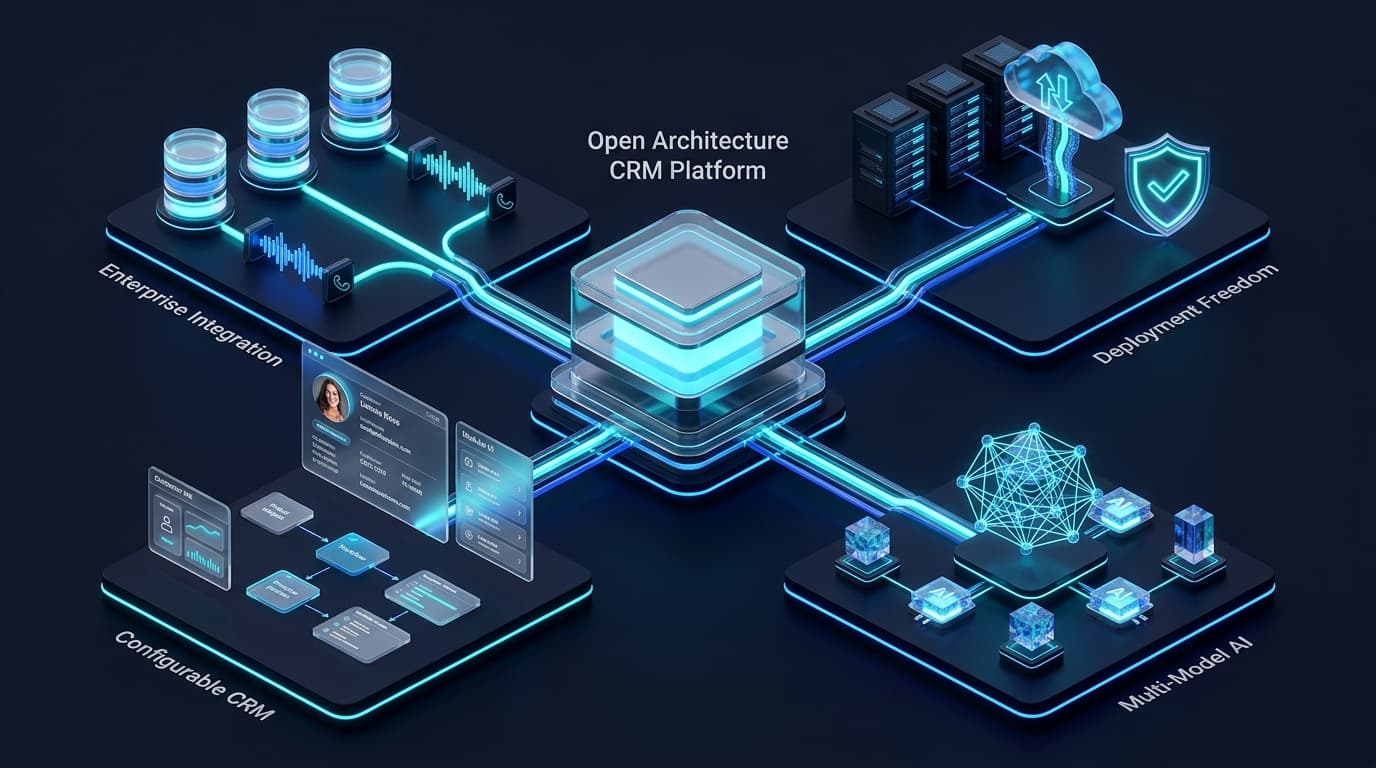
Open Architecture Data & Integration Flow
An open customer platform operates as an active operational switchboard. Rather than requiring data to be duplicated into static tables or replacing established systems, Uniconnect connects your enterprise backends to real-time frontline workflows through a clean, audited four-stage pipeline:
Systems You Run
- Core Banking & Ledgers
- SAP / NetSuite ERP
- Open PBX (SIP / VoIP)
- Snowflake / BigQuery
Open Connectors
- REST & GraphQL APIs
- Real-Time Webhooks
- Low-Latency Events
- iPaaS (Workato / Make)
Uniconnect AI Core
- No-Code Data Modeling
- Dynamic Stage Layouts
- Pluggable Multi-Model AI
- Cloud / VPC / On-Prem
Connected Action
- Omnichannel Inbox
- In-Flight AURI Copilot
- Autonomous Voice Agents
- Zero-Data-Entry Updates
Pillar 1: Connect What You Run (Integration Without the Integration Tax)
Enterprise IT leaders understand a harsh reality that software marketing often ignores: rip-and-replace transformations are organizational catastrophes. The average Global 2000 enterprise operates dozens of mission-critical systems that have taken decades, millions of dollars, and immense institutional effort to stabilize. Demanding that an enterprise replace its core banking transaction engine, its SAP inventory ledger, or its global enterprise telephony system simply to deploy a modern CRM is a non-starter.
An open architecture customer platform meets the enterprise where it is. Rather than demanding total replacement, Uniconnect.ai acts as a high-speed operational orchestrator that connects to your existing infrastructure through three enterprise-grade integration patterns:
1. Bi-Directional REST & GraphQL APIs: Modern customer interactions require sub-second data availability. Uniconnect exposes comprehensive, versioned REST and GraphQL endpoints that allow any external system to query customer state, trigger automated communications, update lifecycle stages, or pull conversational transcripts. Because API contracts are versioned and backward-compatible, external integrations remain stable even as the underlying platform updates.
2. Real-Time Webhook & Event Streaming: Batch ETL processes that synchronize data once every six hours belong to the previous century. When a customer calls a contact center or responds on WhatsApp, the platform generates granular, low-latency lifecycle events (such as `interaction.started`, `intent.classified`, or `sla.breached`). External data warehouses (like Snowflake or BigQuery) and backend processing systems receive real-time streams to trigger downstream financial workflows or update corporate dashboards instantaneously.
3. Open Standard Telephony Interoperability (SIP / VoIP): Voice remains the highest-stakes channel in customer engagement. Traditional CRMs force organizations to purchase expensive proprietary telephony add-ons or contract with exclusive carrier partners. Uniconnect AI supports native SIP/VoIP integration and open standard PBX platforms (such as 3CX). Your enterprise connects its existing SIP trunks, phone numbers, and carrier agreements directly, eliminating redundant per-minute telephony markups while unlocking unified call transcription, sentiment analysis, and autonomous AI voice agents.
4. iPaaS and Managed Connectors: For standard enterprise ecosystems, Uniconnect provides pre-built connector patterns and deep compatibility with leading enterprise integration platforms (including Tray.io, Workato, Make, and Zapier). Frontline teams achieve real-time context fetch—such as displaying active subscription tier, live shipping status, or outstanding invoice amounts directly inside the agent workspace—without writing custom database query scripts.
Pillar 2: Shape Your CRM (Build the Platform Your Process Deserves)
A database schema is not merely a technical artifact; it is the digital representation of how your company creates value. When a software vendor imposes a fixed data model, they are inadvertently imposing their opinion of how your business should run.
In reality, complex enterprises operate workflows that cannot be reduced to simple B2B sales pipelines. Consider how different industries actually operate:
• A wealth management firm does not manage "leads"; it manages Portfolios, Beneficiaries, Compliance Filings, Risk Profiles, and Advisory Mandates.
• An automotive manufacturer manages Vehicles, VIN Numbers, Warranty Registrations, Dealership Networks, and Field Recalls.
• A healthcare provider manages Patients, Care Plans, Insurance Pre-Authorizations, Clinical Encounters, and Provider Networks.
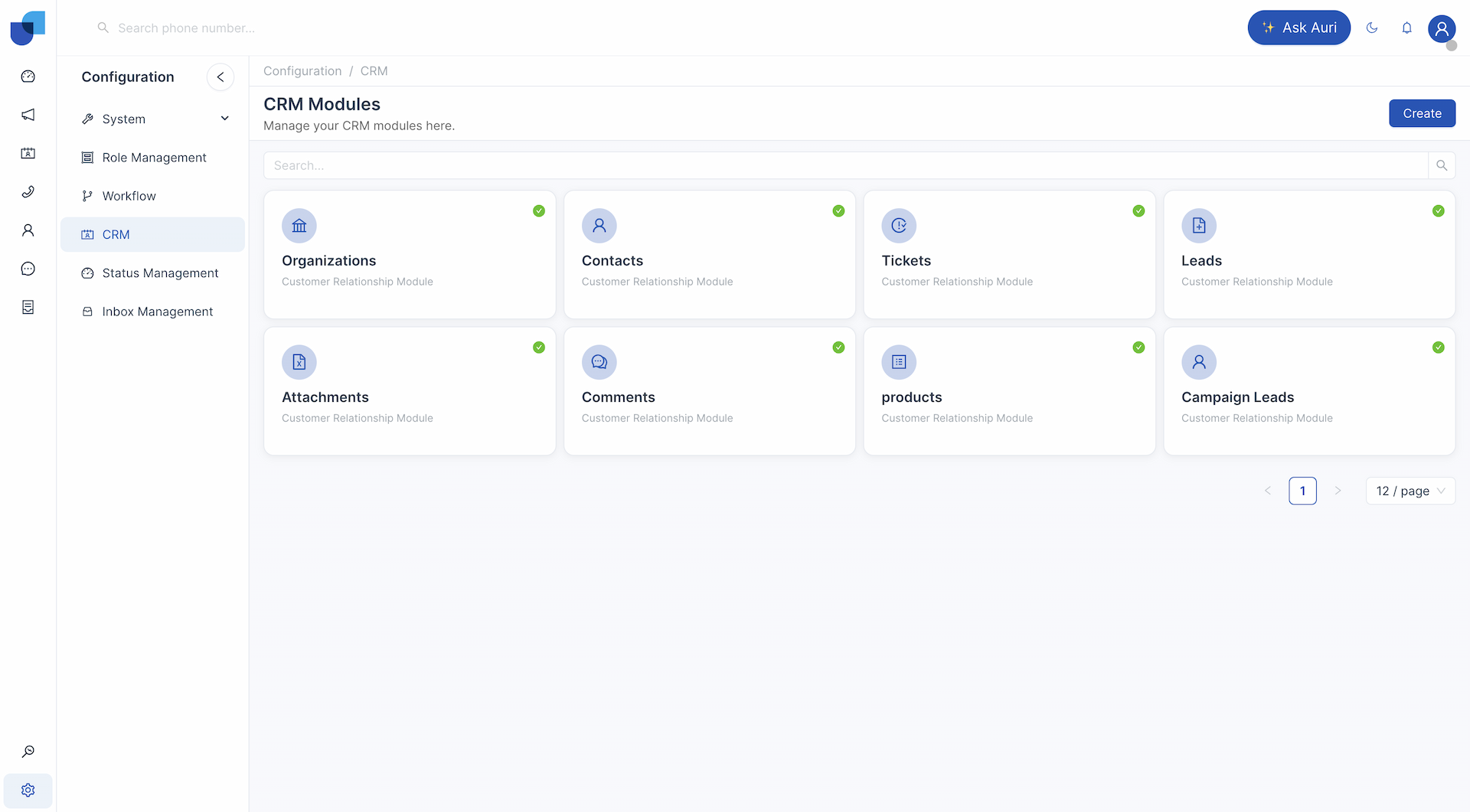
With Uniconnect's No-Code CRM Platform, operations leaders define custom business modules and entities directly within a visual administrative canvas. Teams establish one-to-one, one-to-many, and many-to-many relationships with full referential integrity—ensuring that a single corporate account can link to multiple subsidiary facilities, operational assets, compliance audits, and active customer support cases.
Dynamic Layouts Tailored by Role and Stage: One of the greatest sources of frontline fatigue is interface clutter. A customer support agent troubleshooting an urgent system outage does not need to see complex billing commission tables; an executive examining renewal risk does not need to parse technical error codes. Uniconnect allows administrators to design dynamic, context-aware record layouts. Fields, action buttons, and conversation timelines appear conditionally based on the user's role, the record's current lifecycle state, or automated risk signals.
A Practical Enterprise Walkthrough: Regulated Customer Onboarding
(The following scenario illustrates how an open, configurable data model solves complex cross-departmental operations in practice. Specific workflows are configurable based on enterprise requirements.)
Imagine an enterprise commercial bank onboarding a corporate client. In a rigid legacy CRM, this requires sales reps emailing compliance officers, compliance logging data into a separate portal, and customer support remaining blind to onboarding roadblocks. In Uniconnect's open architecture CRM:
1. Schema Design: Operations creates a custom `Corporate Client` entity linked to multiple `Signatory Documents`, `KYC Verification Checks`, and `Assigned Line of Credit` records.
2. Dynamic UI: When the onboarding stage shifts to "Compliance Review," the record view automatically renders encrypted document upload components, identity verification fields, and regulatory sign-off checkboxes for the compliance team.
3. Event Automation: The moment the client submits their tax documents via WhatsApp or email, a visual workflow triggers an external API call to the national business registry to verify corporate registration numbers.
4. Zero-Data-Entry Capture: When the client calls their relationship manager to clarify an ownership clause, the embedded AURI AI Copilot transcribes the conversation in real time, extracts the legal clarification, populates the corresponding custom CRM field, and marks the compliance task complete—saving twenty minutes of administrative manual labor without a single developer deployment cycle.
Pillar 3: Deploy Where You Decide (Infrastructure Sovereignty & Data Control)
In modern enterprise procurement, where your software runs is just as critical as what features it delivers. Regulatory mandates such as GDPR in Europe, HIPAA in the United States, DORA for financial entities, and regional data residency laws in the Middle East and Asia-Pacific mean that multi-tenant public cloud is not always permissible. Uniconnect provides three architectural deployment models:
Multi-Tenant Public Cloud
Managed SaaSInstant time-to-value with automated high availability.
Dedicated Private Cloud (VPC)
Isolated InfrastructureComplete network isolation inside your enterprise cloud perimeter.
Sovereign On-Premises / Air-Gapped
Maximum ControlTotal infrastructure ownership inside your private data center.
Infrastructure Governance and Shared Responsibility
Deployment flexibility is not a silver bullet that eliminates security responsibility—it is an architectural choice that establishes clear boundaries of operational control.
In a Multi-Tenant Public Cloud deployment, Uniconnect manages high availability, automatic patch management, database scaling, and physical infrastructure security. This model delivers the lowest total cost of ownership and fastest deployment speed for organizations that do not face strict jurisdictional data residency prohibitions.
In a Dedicated Private Cloud or Sovereign On-Premises deployment, the enterprise gains absolute sovereignty over its network perimeter, physical storage disks, and encryption keys. However, the enterprise IT organization assumes operational responsibility for hardware provisioning, local network firewalls, backup disaster recovery protocols, and internal identity governance. Enterprise buyers should evaluate these operational commitments in collaboration with their security and compliance teams during the architecture review phase.
Pillar 4: Choose Your AI (Pluggable Multi-Model Intelligence)
Artificial intelligence has triggered the most rapid technological innovation cycle in human history. Every few weeks, a new foundational model achieves state-of-the-art benchmarks in reasoning, multilingual understanding, code generation, or voice synthesis. One month, OpenAI leads in complex conversational reasoning; the next month, Anthropic delivers breakthrough capabilities in document analysis and safety; shortly thereafter, Google Gemini expands multimodality and context length to millions of tokens.
In this dynamic landscape, committing your enterprise to a single proprietary CRM AI model is an unacceptable strategic risk. When a legacy CRM vendor locks you into their exclusive in-house AI engine, your enterprise suffers four compounding liabilities:
• You are trapped when their proprietary model lags behind frontier capabilities.
• You pay exorbitant per-seat add-on charges (often $30 to $50 per user per month) regardless of actual consumption.
• You surrender prompt data governance, risking your confidential corporate intelligence being processed in shared inference pipelines.
• You cannot leverage cost-optimized smaller models for simple triage tasks or private on-premise models for confidential customer data.
The Pluggable Bring-Your-Own-AI (BYO AI) Architecture:
Uniconnect AI was engineered from the foundation to be AI-neutral and model-agnostic. The platform decouples the customer engagement workflows, CRM records, and conversation history from the underlying machine learning models.
Enterprises simply input their direct organizational API credentials for their chosen provider, or route requests to internally hosted model endpoints:
1. OpenAI (GPT-4o / Reasoning Models): Connect direct OpenAI API keys to power complex multi-step reasoning, autonomous lead qualification, and dynamic email synthesis.
2. Google Gemini (Gemini 2.5): Leverage massive context windows to ingest entire multi-year customer ticket histories, warranty documentation, and extensive product manuals for instant contextual grounding.
3. Anthropic Claude (Claude 3.7 Sonnet): Deploy industry-leading safety guardrails, nuanced tone control, and complex conversational reasoning for sensitive customer disputes.
4. ElevenLabs: Power autonomous, ultra-realistic AI voice agents that conduct fluid, human-grade telephone calls with natural cadence, empathetic tone, and sub-second latency.
5. Private Self-Hosted Models (vLLM / Ollama): For institutions subject to strict air-gapped data residency mandates, connect privately hosted open-source models (such as Llama or Mistral) running entirely within your internal data center. Customer prompts and conversational context never touch public cloud APIs.
The Direct Economic Advantage: Uniconnect AI imposes $0 software markup on foundational AI tokens. Your enterprise pays wholesale token rates directly to your model provider based on exact usage. By combining model neutrality with direct consumption pricing, enterprises eliminate thousands of dollars in redundant seat fees while preserving the architectural freedom to switch models with a single toggle as industry benchmarks evolve.
How to Evaluate an Open Enterprise CRM: The 10-Point Buyer Checklist
Before committing your organization to a multi-year customer platform contract, technical leaders and procurement committees should evaluate prospective vendors against this objective architectural checklist:
- 1. Open API Accessibility & Comprehensive Documentation: Does the platform expose first-class, fully documented REST and GraphQL endpoints for all core CRM entities, interaction logs, and workflow events, or are certain capabilities gated behind proprietary developer licenses?
- 2. Real-Time Event Streaming & Webhook Reliability: Can the platform stream granular, low-latency lifecycle events (interaction started, intent resolved, SLA breached) to external data lakes and microservices with guaranteed delivery and retry logic?
- 3. No-Code Schema Extensibility: Can business operations configure custom entities, multi-dimensional relational links, and dynamic conditional layouts through a visual designer without requiring software engineering sprint cycles?
- 4. Pluggable AI Provider Independence: Does the vendor allow you to bring your own API keys for leading frontier models (OpenAI, Anthropic, Google Gemini, ElevenLabs) and private LLMs at direct token cost, or are you forced into a proprietary, marked-up AI bundle?
- 5. Flexible Infrastructure Deployment Options: Does the platform support Dedicated Private Cloud (VPC) and Sovereign On-Premises air-gapped deployments for regulated data residency requirements, or is it strictly multi-tenant public SaaS?
- 6. Granular Role-Based & Field-Level Access Governance: Can administrators configure granular view, edit, and export security policies at the individual field level, with comprehensive audit trails recording every record interaction and API request?
- 7. Complete Data Portability & Unencumbered Exit Terms: Can your enterprise export its entire relational dataset, custom object schemas, and interaction history in standard open formats (JSON, Parquet, CSV) without prohibitive egress fees or proprietary schema locks?
- 8. Resilient, Non-Breaking Upgrade Architecture: Are custom fields, dynamic layouts, and API integrations decoupled from core platform engine updates, guaranteeing that system upgrades never break enterprise customizations?
- 9. Open Telephony PBX Interoperability (SIP / VoIP): Can the platform connect directly to your existing open standard PBX (such as 3CX) and carrier SIP trunks, or does the vendor require you to rip and replace your existing enterprise phone system?
- 10. Transparent Total Cost of Ownership (TCO): Does the pricing model consolidate CRM, omnichannel inbox, automated workflows, and reporting into a single transparent tier, or does the quote rely on hidden fees for API calls, storage tiers, and integration connectors?
How Uniconnect.ai Unifies Open Architecture into a Single Enterprise Platform
An open architecture does not mean assembling a dozen disjointed software components and spending years maintaining the glue between them. That was the failed promise of the stitched stack.
Uniconnect.ai delivers the best of both worlds: the unified cohesion of an all-in-one customer engagement platform combined with the freedom and extensibility of an open architecture. Within a single governed platform, enterprises access:
• [Omnichannel Inbox](/product/omnichannel-inbox): Unify voice phone calls, WhatsApp Business messaging, email, SMS, and web chat into a single agent workspace with persistent customer timelines and zero context loss.
• [AURI AI Agents & Copilot](/product/ai-agents-copilot): Deploy in-flight agent assistance that transcribes calls, drafts responses, and executes post-contact CRM hygiene, alongside autonomous tier-1 AI agents that resolve routine customer requests 24/7.
• [No-Code CRM Platform](/product/no-code-crm): Design custom data models, manage complex entity relationships, build dynamic layouts, and automate multi-step business workflows visually.
• [Outbound Campaigns](/product/campaigns): Coordinate automated, intelligent multi-channel outreach campaigns across WhatsApp, email, voice, and SMS with smart pacing and dynamic retry logic.
• [Business Intelligence](/product/business-intelligence): Query conversational datasets and operational metrics using natural language queries (NLQ), with out-of-the-box dashboards for CSAT, FCR, handle times, and sentiment trends.
• [Enterprise Integrations & APIs](/product/integrations): Connect seamlessly with your core banking engines, ERPs, ticketing portals, and Snowflake data warehouses through secure, versioned integration primitives.
By removing the friction between systems, data models, infrastructure environments, and AI models, Uniconnect empowers enterprises to innovate at their own pace. You retain complete ownership over your customer data, total sovereignty over your infrastructure, and complete freedom to shape your customer experience around your unique competitive advantages.
Frequently Asked Questions (FAQ)
What is an open architecture CRM?
What is the difference between an open CRM and a traditional CRM?
Can an enterprise CRM integrate with existing systems without replacement?
Why does CRM customization matter for enterprise operational efficiency?
Can enterprises choose their own AI models in Uniconnect.ai?
What should enterprises consider when choosing a CRM deployment model?
How can businesses reduce CRM vendor lock-in?
Your enterprise has its own way of working. Your customer platform should support it. Discover how Uniconnect.ai helps you connect existing systems, shape your CRM around your operations, and choose an architecture that fits your business.
Uniconnect AI Strategy & Architecture Team
Updated October 9, 2026