
Every enterprise eventually hits the same architectural wall: the moment your customer platform stops serving your business and starts dictating how your business is allowed to operate. Legacy SaaS vendors sell the promise of unified customer experience, only to lock organizations inside a rigid, closed ecosystem—mandating predefined CRM templates, forcing data onto vendor-controlled multi-tenant servers, and bundling proprietary AI models at steep per-seat markups.
For high-volume, regulated enterprises in banking, telecom, healthcare, logistics, and retail, ripping out core transactional systems—like core banking ledgers, SAP or NetSuite ERPs, billing engines, or existing SIP telephony—is neither realistic nor desirable. Your customer platform should adapt to the infrastructure that already runs your business, not demand a multi-year migration.
At Uniconnect AI, our second foundational principle—02 · Open by Design—reverses this legacy power dynamic. Fits your enterprise, not the other way round. Keep the systems you run, shape a no-code CRM around your exact operational model, deploy on the cloud or on-premise environment you govern, and swap AI models freely as frontier intelligence evolves.
Combined with our first pillar—01 · AI That Acts—Open by Design ensures that autonomous AI agents operate directly on top of your trusted systems with zero vendor lock-in.
Key takeaways
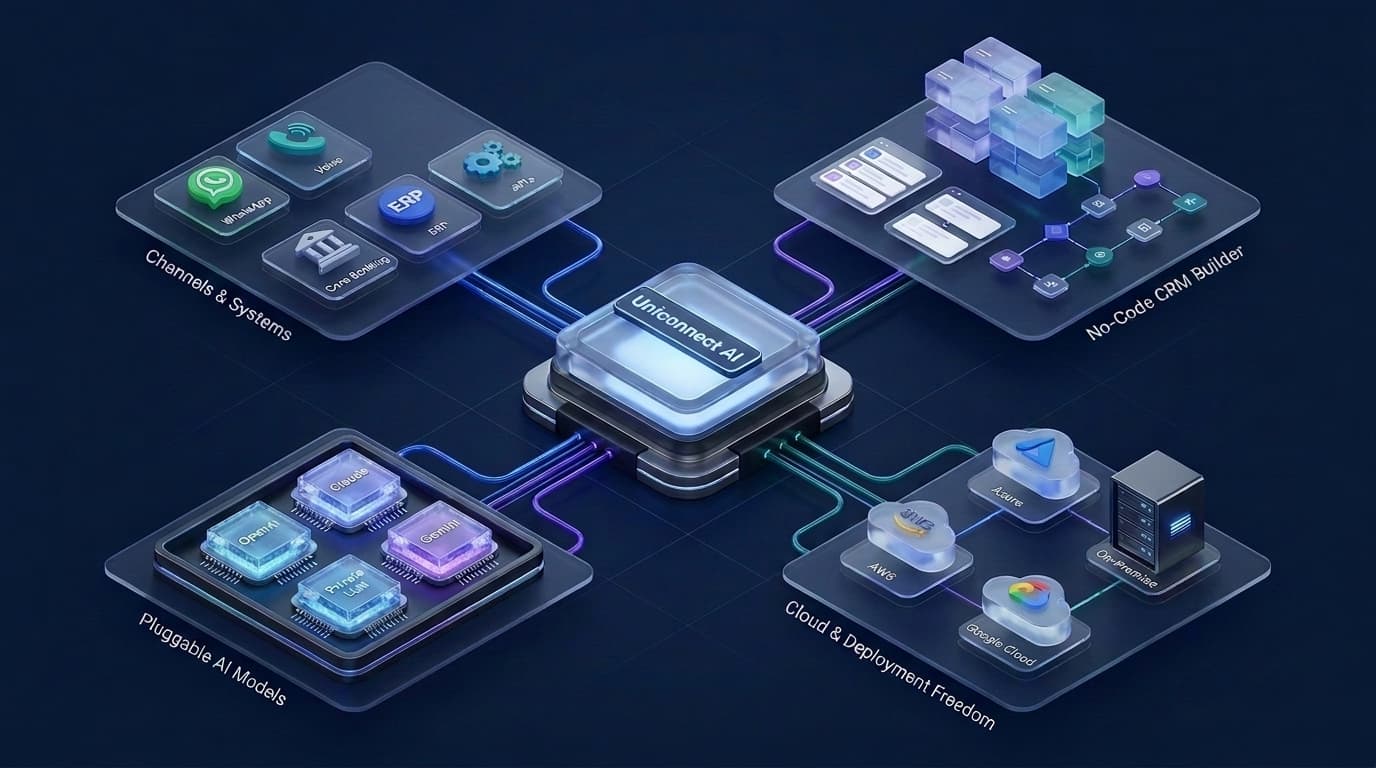
- Open by Design decouples customer operations into four independent, hot-swappable layers: Channels & Systems, No-Code CRM Core, Pluggable AI Models, and Deployment Infrastructure.
- Connect What You Run: Integrate core banking, billing, ERP, e-commerce, existing CRMs, and omnichannel touchpoints (Voice, WhatsApp, Email, Chat, Social) via REST/GraphQL APIs, webhooks, and event streams.
- Shape Your CRM: Build custom data models, entity relationships, dynamic layouts, and visual workflows with zero engineering tickets or rigid industry templates.
- Choose Your AI: Run Auri on OpenAI, Anthropic Claude, Google Gemini, ElevenLabs, or your own Private LLM—swapping models without changing your workflows or paying software token markups.
- Deploy Where You Decide: Containerized for Kubernetes across AWS, Microsoft Azure, Google Cloud, private VPCs, or air-gapped on-premise data centers so sensitive customer data never leaves your perimeter.
- Zero Rip-and-Replace: Selecting a new AI model or migrating cloud targets only changes that single layer; every workflow, record, and customer conversation above it stays intact.
What Does "Open by Design" Mean in an Enterprise Customer Platform?
Unlike "open-core" marketing claims that merely expose rate-limited REST endpoints, true openness at enterprise scale means layer independence. Your telephony carriers, core transactional databases, CRM object schemas, AI inference providers, and Kubernetes hosting targets are decoupled cleanly.
When your security team mandates moving workloads from a public cloud to a sovereign on-premise data center, or when your AI engineering team decides to route complex reasoning to Anthropic Claude and ultra-low-latency voice to Google Gemini, only that single layer changes. Everything else keeps running without downtime.
Why Closed, Template-Driven Platforms Break at Enterprise Scale
Traditional CRM and contact center suites were engineered as monolithic walled gardens. While they accelerate initial setup for small teams with generic sales pipelines, they introduce severe structural friction for complex enterprises:
1. Rigid Data Templates vs. Real-World Operations: Standard CRM schemas assume every organization operates identically around basic Leads, Contacts, and Opportunities. In reality, a telecom carrier manages SIM provisioning and tower SLA tickets; a bank manages loan origination, KYC verification, and dispute ledgers; a logistics provider tracks waybills, customs clearances, and fleet windows. Closed platforms force operations teams to contort real business logic into awkward custom fields.
2. The "Rip-and-Replace" Fallacy: Legacy vendors frequently demand that enterprises abandon established billing engines, ERP databases, or 3CX/SIP voice trunks in favor of the vendor’s proprietary add-ons. This creates brittle ETL batch syncs, duplicated customer records, and multi-million-dollar system integrator backlogs.
3. Forced AI Lock-In and Margin Stacking: As generative AI matured, incumbent CRM vendors rushed to bundle a single proprietary copilot—charging $30 to $75 per user per month on top of existing licenses while restricting organizations from using their own private models or direct enterprise API keys.
4. Data Residency & Sovereignty Deadlocks: Multi-tenant public SaaS clouds often violate strict banking, healthcare, and government data residency mandates. Without containerized private cloud or on-premise deployment options, compliance teams are forced to block AI adoption altogether.
The Four Architectural Pillars of Open by Design
Uniconnect AI structures enterprise openness across four concrete layers so IT leaders retain total control over data, logic, intelligence, and infrastructure:
Connect What You Run
Seamless integration without ripping out core systems.
Connect core banking, billing, ERP, e-commerce, existing CRMs, and every customer channel—Voice, WhatsApp, Email, Chat, and Social—through high-throughput REST APIs, webhooks, event streams, and no-code connectors.
Shape Your CRM
No-code data modeling without templates or dev tickets.
Design your own custom data models, multi-object relationships, dynamic stage layouts, and visual workflow automation directly in the browser—tailored to your exact operational rules.
Choose Your AI
Model-agnostic intelligence with zero lock-in.
Run Auri on OpenAI, Anthropic Claude, Google Gemini, ElevenLabs, or your own Private LLM. Swap models per workflow or upgrade as the market moves without rebuilding a single process.
Deploy Where You Decide
Public cloud, private VPC, or sovereign on-premise.
Containerized for Kubernetes to run natively in your AWS, Microsoft Azure, or Google Cloud account—or inside your own air-gapped on-premise data center.
How the Open by Design Stack Operates End-to-End
From inbound omnichannel signals and backend ERP events to model-agnostic AI reasoning and sovereign infrastructure execution, every layer communicates over open standards:
Systems You Run
- Core Banking & Ledgers
- SAP / NetSuite ERP
- Open PBX (SIP / VoIP)
- Snowflake / BigQuery
Open Connectors
- REST & GraphQL APIs
- Real-Time Webhooks
- Low-Latency Events
- iPaaS (Workato / Make)
Uniconnect AI Core
- No-Code Data Modeling
- Dynamic Stage Layouts
- Pluggable Multi-Model AI
- Cloud / VPC / On-Prem
Connected Action
- Omnichannel Inbox
- In-Flight AURI Copilot
- Autonomous Voice Agents
- Zero-Data-Entry Updates
Architectural Comparison: Closed SaaS Monolith vs. Open by Design
Evaluating how an open, composable customer platform compares against legacy proprietary suites across critical CIO decision criteria:
| Capability | Uniconnect AI (Open by Design) | Closed Proprietary SaaS Suite |
|---|---|---|
| Core System Integration | Native REST/GraphQL APIs, real-time webhooks, event streams, and open SIP/3CX telephony bridges with zero rip-and-replace. | Rate-limited proprietary APIs, brittle batch ETL syncs, and expensive middleware connectors. |
| CRM Schema & Layouts | Full No-Code CRM builder: custom data models, relationships, dynamic layouts, and visual workflows with zero engineering tickets. | Locked into rigid predefined objects; custom workflows require certified developers or system integrator retainers. |
| AI Model Selection | Hot-swappable multi-model support: OpenAI, Anthropic Claude, Google Gemini, ElevenLabs, or self-hosted Private LLMs. | Locked into a single vendor-packaged LLM with steep per-user AI add-on surcharges. |
| Hosting & Data Sovereignty | Deploy in AWS, Azure, Google Cloud, private VPC, or on-premise Kubernetes clusters with your own encryption keys. | Forced onto vendor-controlled multi-tenant public cloud servers outside your network perimeter. |
| Upgrade & Migration Risk | Modular layer isolation: swap an AI model or cloud target while every workflow and customer record above it stays put. | Deep vendor lock-in; extracting historical data and rebuilding workflows is commercially and technically punitive. |
Core System Integration
CRM Schema & Layouts
AI Model Selection
Hosting & Data Sovereignty
Upgrade & Migration Risk
Deployment Decision Matrix: Choosing Where Uniconnect AI Runs
Because Uniconnect AI is containerized for Kubernetes, enterprises choose the exact hosting topology that satisfies their security, compliance, and latency requirements:
AWS / Azure / Google Cloud (Your Tenant)
Customer Cloud VPCRunning inside your AWS account, Azure tenant, or Google Cloud project.
On-Premise / Sovereign Data Center
Air-Gapped SovereignRunning in your own data center. Nothing leaves your environment.
Uniconnect Managed Cloud
Turnkey EnterpriseDedicated single-tenant cloud environment managed 24/7 by Uniconnect SREs.
Inside the Hub: No-Code CRM Meets Pluggable Multi-Model AI
Two capabilities turn open connectivity into day-to-day competitive advantage inside Uniconnect AI: our No-Code CRM and our Pluggable AI Layer.
1. Shape Your Own CRM Without Code: When omnichannel conversations from Voice, WhatsApp, Email, Chat, and Social converge with backend events from SAP, core banking, or e-commerce, your operations leaders can model custom entities—such as Policies, Claims, Shipments, Subscriptions, or Loan Schedules—directly in the No-Code CRM. Dynamic layouts surface only the exact fields and next-best actions an agent needs for each lifecycle stage, eliminating screen clutter and training time.
2. Swap AI Models Without Breaking Workflows: AI capabilities evolve every quarter. One month, Anthropic Claude may excel at complex policy reasoning; the next, Google Gemini may offer superior speed for real-time voice translation, or your compliance team may mandate a self-hosted Private LLM for sensitive financial records. In Uniconnect AI, your workflows, prompts, and CRM permissions sit above the model layer. Selecting a different provider updates the inference engine immediately—everything above it stays put.
Security, Auditability, and Sovereignty by Default
Openness never compromises security. Every integration, custom schema, and AI model call inside Uniconnect AI is governed by enterprise-grade security controls:
- Encryption in Transit & at Rest: TLS 1.3 across all API and SIP channels, paired with AES-256 storage encryption using customer-managed keys (BYOK).
- Strict Tenant Isolation: Dedicated database schemas and isolated execution contexts prevent cross-tenant data leakage.
- Role-Based Access Control (RBAC): Granular field-level permissions govern both human agents and autonomous Auri AI agents equally.
- Immutable Audit Trails: Every API call, schema change, AI decision, and customer record mutation is timestamped and logged for compliance audits.
- Zero Model Training Guarantee: Enterprise data routed through pluggable AI APIs is never stored or used to train public foundation models.
Uniconnect AI: Open Architecture Without the Integration Tax
Historically, achieving true architectural openness meant hiring a massive systems engineering team to stitch together separate CRMs, middleware iPaaS tools, telephony servers, and custom LLM orchestration scripts. You got flexibility, but paid a crushing maintenance tax.
Uniconnect AI delivers Open by Design out of the box. You get one cohesive customer platform where Omnichannel Inbox, No-Code CRM, Workflow Automation, Business Intelligence, and Auri AI Agents share a single live customer record—while remaining completely open to your existing systems, your cloud, and your choice of AI.
And when paired with our third pillar—03 · Simple to Own—you get this entire enterprise architecture under one transparent per-user license with zero platform fees or AI markup. Explore our transparent pricing or compare how we stack up against legacy suites in our CRM comparison guide.
Frequently Asked Questions About Open by Design Architecture
Can we keep our existing ERP, core banking, or billing system when adopting Uniconnect AI?
Which AI models can we connect to Uniconnect AI?
Can Uniconnect AI be deployed on-premise or inside our own AWS, Azure, or Google Cloud account?
Do we need software developers to customize the CRM data model and workflows?
What happens to our workflows if we switch AI models or change hosting environments?
See how Uniconnect AI fits your existing systems, your cloud environment, and your preferred AI models in a live 30-minute architecture session.
Uniconnect AI Strategy & Architecture Team
Updated November 27, 2026